

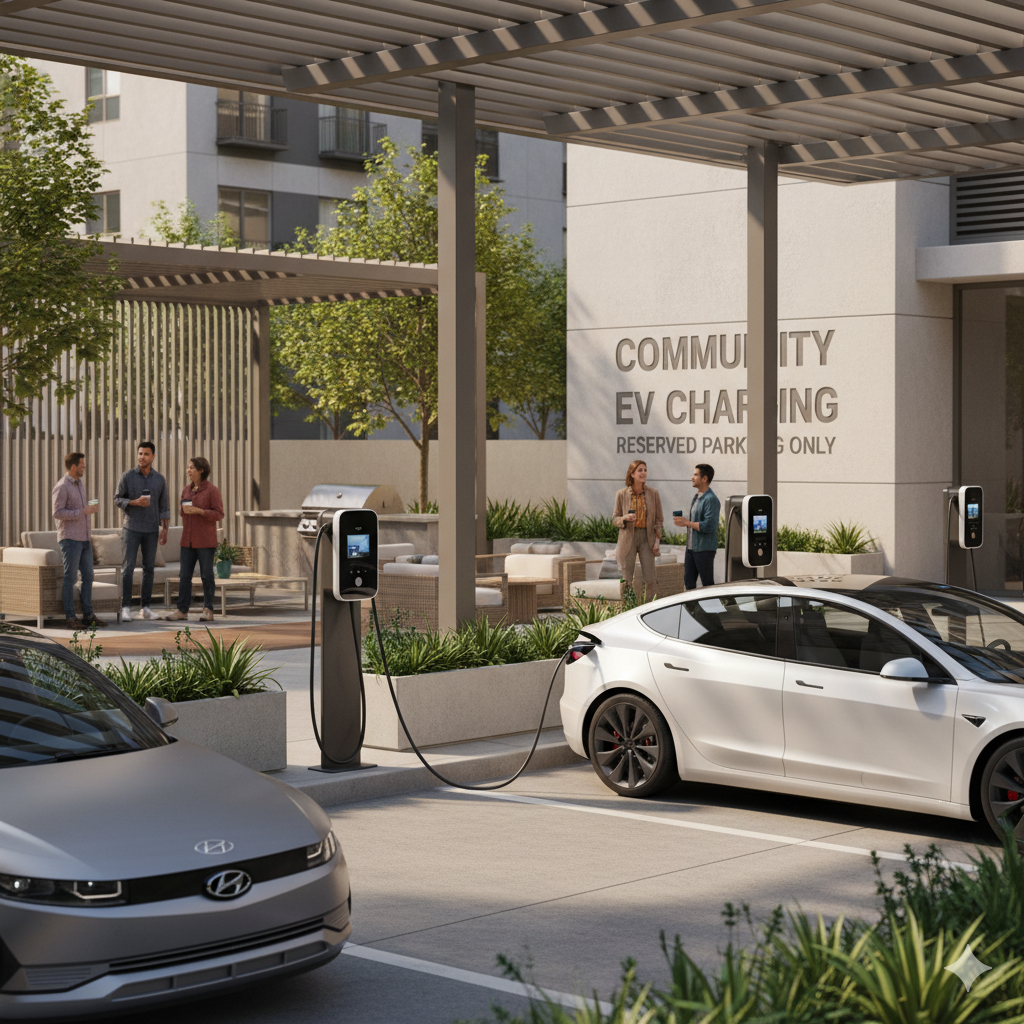
What if EV owners or visitors charge their vehicle in a common property power point?
Q: Can an EV owner or visitors charge their vehicle in a GPO in their own garage, which is part of the communal electricity costs, meaning everyone pays for their EV charging?
EV owners across the country routinely charge from a general-purpose outlet (GPO) in their garage or driveway. It’s a very common practice, especially for drivers who typically drive less than ~150km per day. This is fine, provided they’re the ones paying the bill for the electricity. This is almost always the case in standalone homes and will often be the case in strata settings like townhouses and units, but it is not always the case in apartment blocks. They sometimes have private garages supplied by common property power.
In that case, ‘fair’ looks like making sure that the non-EV drivers in the building aren’t picking up the tab for the energy going into one resident’s car.
There’s a spread of ways to achieve this, inclusive of, but not limited to:
- Shared EV chargers in buildings can be installed with software over the top, so the driver pays with their credit card.
- Sub-metering can be installed in individual garages or allocated parking spaces to measure the energy used for EV charging by a specific resident. The measured value can be used as the basis for cost recovery by the owners corporation, subject to suitable by-laws. Regulations around sub-billing and embedded networks vary by jurisdiction. Plenty of specialist providers can assist you.
- If you’re looking for a really simple approach as a starting place, without installing anything, take the odometer reading from the car and multiply the kilometres travelled by 4.2 cents to determine a ‘reasonable value for the electricity’. The ATO has some guidance along these lines, which wasn’t designed for this specific purpose, but which will work, subject to a suitable by-law in the building: PCG 2023/D1 – Electric vehicle home charging rate – calculating electricity costs when a vehicle is charged at an employee’s or individual’s home.
In any of the above cases, it’s a good idea to encourage drivers not to charge their cars at peak time. Peak time EV charging will tend to drive up the common property bill (due to capacity charges associated with peak power draw). It will potentially bring forward the need for electrical upgrades.
Setting the car to charge off-peak is easy for the driver to do; it just needs to be encouraged.
Ross De Rango | Electric Vehicle Council Ross@evc.org.au